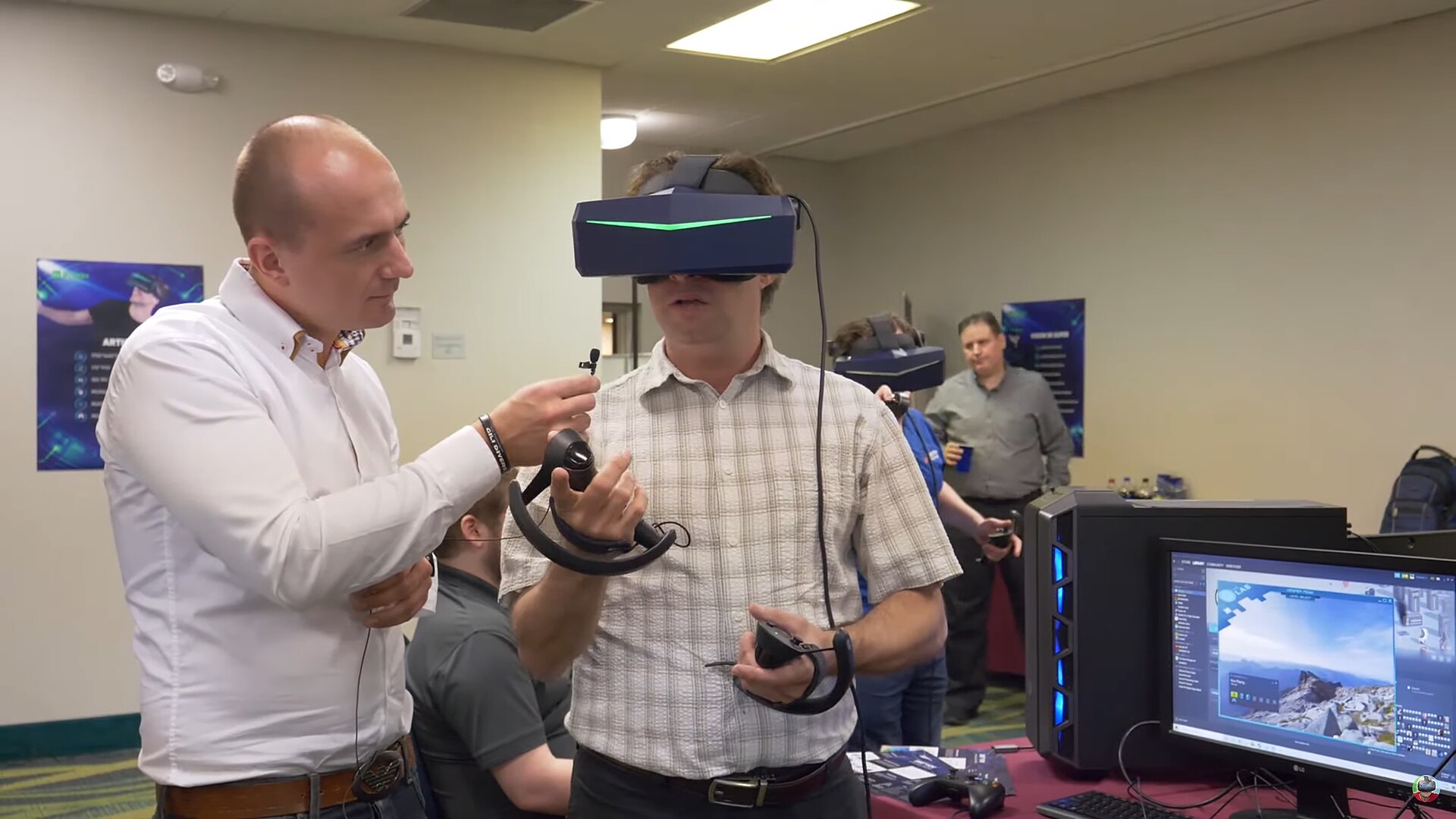
Pimax announced the Crystal Pro on Tuesday, a wireless PC VR headset that costs $1,399 on its own or $1,899 bundled with a new 60GHz wireless kit. The pitch is aimed squarely at people who want PC-quality visuals without a cable, and it lands three weeks after Valve put a price on its own streaming-first headset, the Steam Frame. You can't buy one yet, though. Pimax says shipping dates will come later, and Road to VR reports the headset is slated for next year.
The headline feature is what Pimax calls Native Foveated Streaming. According to Pimax's announcement, the headset tracks your eyes 120 times a second, and when the optional third-generation 60G AirLink kit is installed, it sends the GPU's image to the area you're looking at without any video compression. The kit uses two room antennas in a 2x2 MIMO setup, which Pimax says is a first for a VR headset, for up to 6 Gbps of throughput and under 2 milliseconds of added latency. Without the kit, Crystal Pro streams over ordinary Wi-Fi 6E with an adapter that comes in the box.

Crystal Pro vs Steam Frame on paper
Steam Frame is the obvious comparison, since both headsets are built around wireless PC streaming and both use eye tracking to spend bandwidth where your eyes are. Valve revealed Steam Frame's price on Sept. 14, and UploadVR's coverage lists $1,059 for the 256GB model and $1,299 for 1TB. Here's how the two line up using Pimax's spec sheet and published Steam Frame specs.
| Pimax Crystal Pro | Valve Steam Frame | |
|---|---|---|
| Price (US) | $1,399, or $1,899 with 60G AirLink | $1,059 (256GB) or $1,299 (1TB) |
| Display per eye | 2880 x 2880 QLED with 576-zone Mini-LED dimming | 2160 x 2160 LCD |
| Refresh rate | 72, 90 or 120Hz | 72 to 144Hz (144Hz experimental) |
| Horizontal field of view | 110 degrees | 110 degrees |
| Onboard chip | Snapdragon XR2 Gen 1 | Snapdragon 8 Gen 3, 16GB RAM |
| PC wireless link | Wi-Fi 6E adapter included; optional uncompressed 60GHz kit | Dedicated Wi-Fi 6E adapter included; compressed foveated stream |
| Power | External 16,000mAh battery pack | Battery at the back of the strap |
| Passthrough | Optional MR faceplate with color and LiDAR | Monochrome |
| Base stations | Optional Lighthouse faceplate | Not supported |
The pixel gap is the biggest difference. Crystal Pro's panels have 8,294,400 pixels per eye against Steam Frame's 4,665,600, which works out to about 78% more. Pimax pays for that sharpness in other places, though. The onboard chip is the Snapdragon XR2 Gen 1 that Meta used in the Quest 2, so the standalone Android and OpenXR games Pimax mentions will be lightweight next to what Steam Frame can run on its own, and the headset has no built-in battery at all.
On price, the base Crystal Pro costs $340 more than the cheapest Steam Frame, and the AirLink bundle costs $840 more. If you're already sure you want one, the $1 reservation Pimax opened today knocks $20 off the headset or $50 off the bundle at launch, according to the company, though Road to VR notes the dollar isn't refundable.
Why the 60GHz kit only covers part of the image
It's worth doing the bandwidth math, because "uncompressed" sounds like more than it is. Two 2880 x 2880 panels add up to 16,588,800 pixels. At 24 bits of color per pixel, one frame is roughly 398 million bits, and at 90 frames per second that's about 35.8 Gbps. The AirLink kit tops out at 6 Gbps, or roughly a sixth of what a fully uncompressed picture would need, even before any protocol overhead. That's why Pimax describes native image quality "in the user's focus area" rather than across the whole display, and why the eye tracking matters so much. It's also the same basic idea PC Gamer explained behind Valve's approach, which sends a sharp view of where you're looking alongside a lower-resolution view of everything else. The difference is that Valve compresses its stream over Wi-Fi and Pimax is betting a dedicated 60GHz link can skip the compression where it counts.
There are practical catches. Pimax says the 60GHz signal doesn't pass through walls, so the room antennas need a clear line of sight, and Road to VR lists an RTX 2070 as the minimum GPU with an RTX 3080 or 4070 recommended. None of Pimax's latency or image-quality claims have been tested independently yet, because no reviewers have one.
Our take: if you're a sim racer or flight-sim player with a strong GPU and a dedicated play space, Crystal Pro is the most interesting wireless headset on paper this year, and a $1 reservation is a cheap way to hold your place. Everyone else should wait for hands-on reviews and a real ship date. If you want wireless PC VR you can actually buy into now, with better standalone performance and a lower price, Steam Frame is the safer bet.
Source: Pimax, with reporting from Road to VR and UploadVR.