
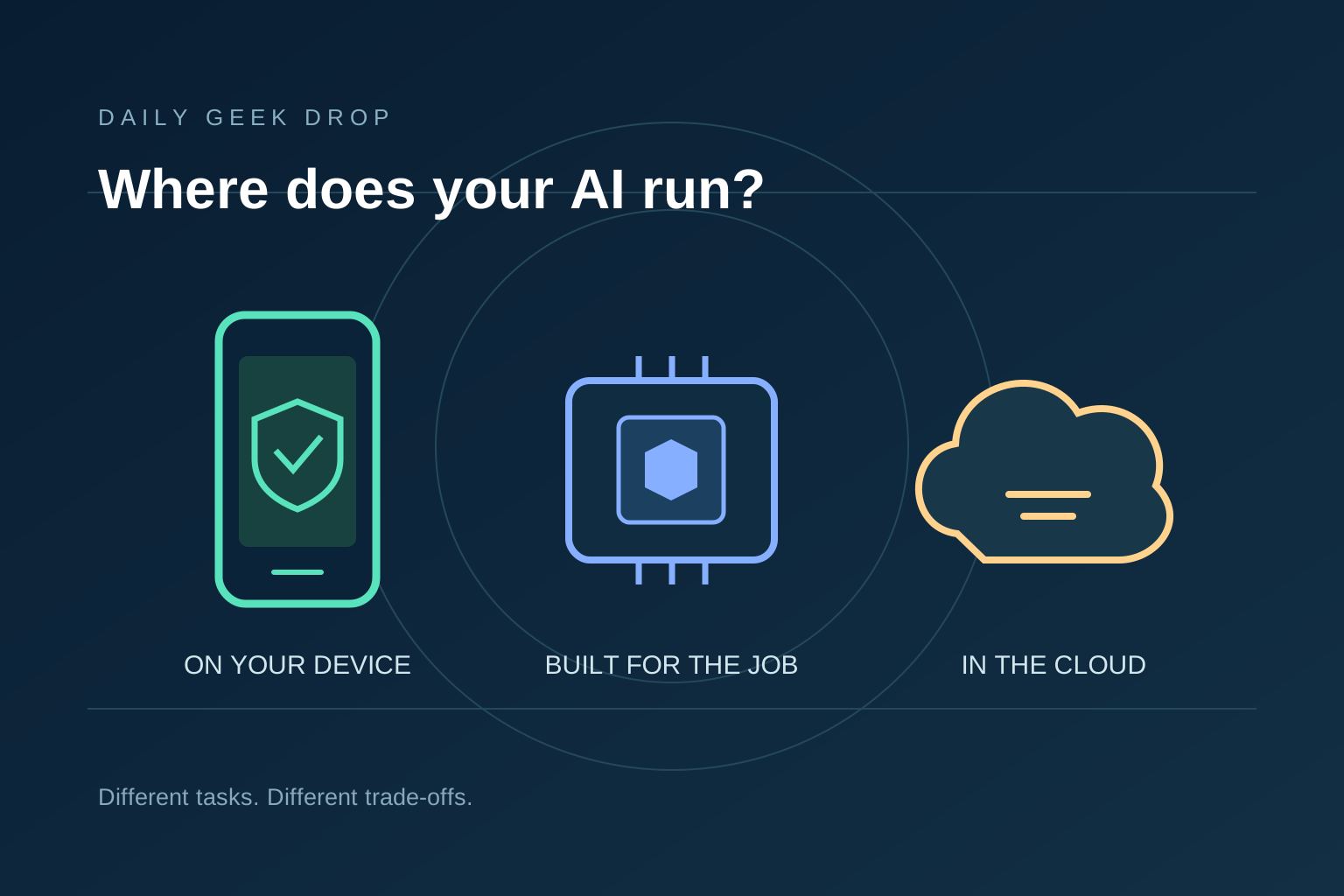
A scam warning that never sends your conversation to a server is a different product from an assistant that hands requests to the cloud. Both get called AI. This week's announcements make that label less useful than a simpler question: where does the work actually happen?
For October 14's Daily Geek Drop, three developments point to a more practical way to judge these tools. Start with the job, the information it needs and the hardware doing the work. Bigger models aren't automatically the right answer, and a smaller device doesn't automatically mean local processing.
A phone can interrupt a scam
Google DeepMind's Singapore project, announced October 14 with GovTech, uses a lightweight Gemma model adapted to local scam conversations. The design analyzes conversations on the device and warns when it detects manipulation, rather than relying on cloud scanning of private chats.
A two-stage system matters here: a light screening step passes suspicious material to a more detailed conversation analysis. Running the heavier step selectively is an attempt to make protection practical on ordinary phones without treating every message as an expensive AI task.
That gives the technology a concrete purpose: interrupt a dangerous interaction before someone shares money or credentials. It doesn't establish that every warning will be correct. The announcement isn't evidence that this protection is installed on your phone, either. Until an actual app or operating-system integration reaches you, keep checking unexpected requests through a separate, trusted channel.
Specialized doesn't mean on-device
Prime Intellect's October 13 acquisition announcement brings Moondream's vision models and Photon inference engine into its platform. It says Moondream 3.1 is already available through Prime Inference, while broader integration work continues.
This is a different efficiency story. A model focused on understanding images can be paired with software built to serve it efficiently. That doesn't turn a hosted service into an offline feature, or make its privacy properties interchangeable with a phone-local scam detector.
The company publishes striking speed and cost comparisons, but some supporting measurements are identified as unpublished internal evaluations. Don't turn those into a universal performance promise. If you're building an image-heavy application, compare results on your own images, including failures, before deciding that a specialist replaces your general-purpose model. The acquisition is confirmed; the best choice for your workload still needs testing.
A smart speaker can still need the cloud
Apple's HomePod mini 2 announcement describes Siri requests using either on-device processing or Private Cloud Compute. Apple says data processed through the latter isn't stored or accessible to it. That's a specific cloud-processing claim, not a statement that every request stays inside the speaker.
The hardware reaches stores October 30 at US$149, while Siri AI arrives through a future software update. Personal-context features also depend on pairing with an Apple Intelligence-enabled iPhone or iPad.
Those distinctions are more useful than another list of promised assistant abilities. If you want the speaker for its coming AI features, wait until they're available and reviewed. If you want it for audio, judge the audio.
Across all three stories, ask the same questions before adopting anything: what task does it perform, what leaves your device, and what is available now? A focused tool can be excellent without doing everything. A promising announcement still has to become a dependable product before you rely on it.